Making Sense of the Open-Weight Discourse
Are open-weight models better than closed-weight models?
Open-weight models have gotten a lot better, and the discourse surrounding them has heated up:
1. GLM 5.2 release

2. Posts on Twitter
The claims seem to be that:
- Open-weight models are cheaper than closed-weight models
- Open-weight models allow you to own your data and infra
- Open-weight models can be trained and improved
When reading this discourse, one might come up with the following mental model:
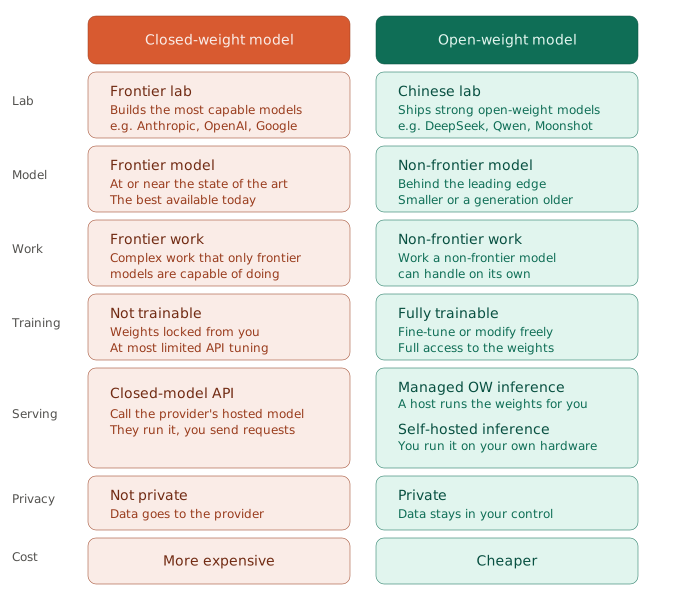
Claim 1: Open-weight models are cheaper to run than closed-weight models
This may currently be true with GLM 5.2, but there's no fundamental reason why open-weight models should be cheaper to run than closed-weight models.
In fact, frontier labs are well-positioned to deliver cheaper closed-weight models:
- Frontier labs will continue to develop closed-weight models that compete with open-weight models on cost.
- Frontier labs have more resources to optimize their inference stack than startup inference platforms like Baseten/Modal or teams running self-hosted infra.
- Frontier labs have the financial resources to subsidize inference more agressively than less well-funded competitors.
I think in the long run, only open-weight models served by hyperscalers might rival the cost of closed-weight models.
Claim 2: Open-weight models allow you to own your data and infra
True, if you are self-hosting your model. However, most people running open-weight models are doing so on managed inference infra, where they are still handing their tokens to a third party.
Still, there is a real perception that frontier labs are very willing and able to compete directly with their customers. So there may be a dynamic where a business gives their tokens to the least threatening provider, even if all providers have the same policies on not training on customer data.
Claim 3: Open-weight models can be trained and improved
This is not necessarily the case:
- Post-training is not trivial and the model can see very little improvement (or even get worse!)
- Post-training can be expensive and needs to be done every time the base model is updated
- It may be more fruitful to focus on improvements in the context and agent layer
Some additional food for thought
Frontier labs should empower customers
A large part of this discourse is caused by businesses wanting to control their IP. Frontier labs must foster a world in which value is distributed across companies and consumers rather than only accruing to the labs themselves. Otherwise, companies will use open-weight models, even if they are worse in cost and quality.
The future of open-weight models is uncertain
Fable set a clear capability threshold at which AI models should be regulated. Frontier labs, having hit this threshold, will continue to march on. As open-weight models approach this threshold, it's unclear how their use will be regulated or restricted.
Frontier labs will be the best at model routing
Model routing, across open-weight and closed-weight models, is a popular topic when it comes to saving costs. It's intriguing, but makes the most sense when done by frontier labs instead of by third parties.
There are two reasons for this:
- There is no way to preserve the KV cache and raw reasoning trace when routing is done by third parties
- Frontier labs are the best at knowing which tasks suit their models
Third parties do have the advantage of routing across models from different companies, but my bet is that a frontier lab can deliver more value by routing among its own suite of models efficiently.